Co-Beitrag | 7 mar 2026
Between Final Fantasy and Fan Frustration: Has Magic: The Gathering Lost Its Identity?
Author: Lloyd-E. Heller / Editor: Tim Groß
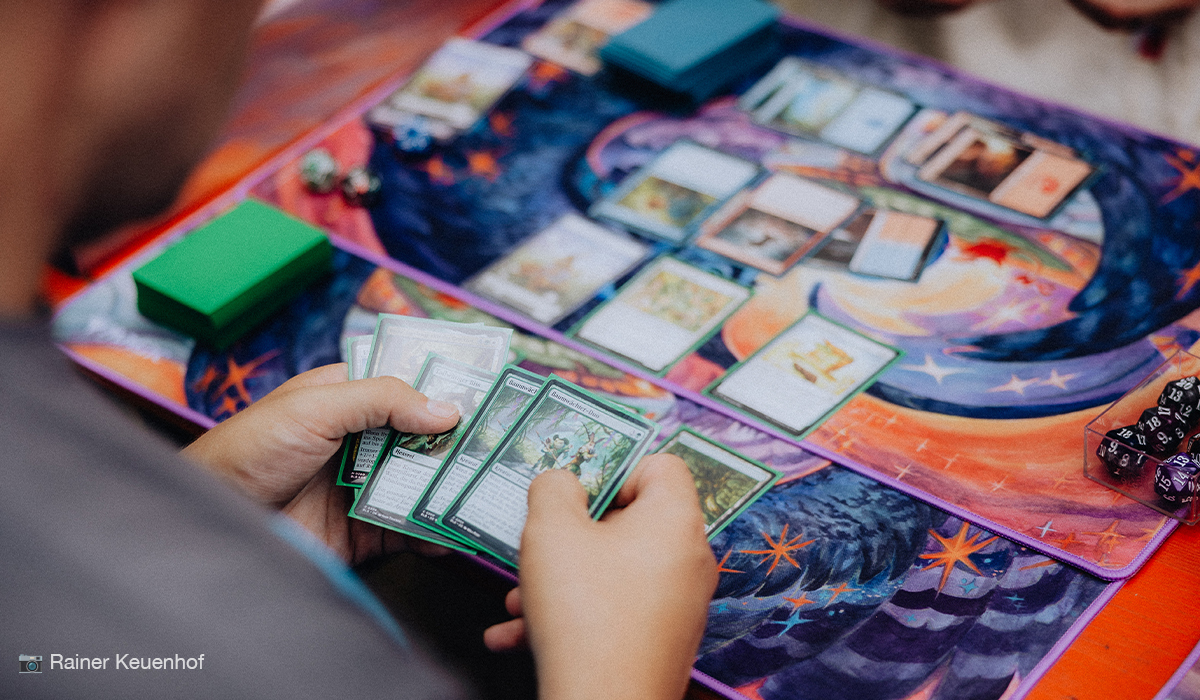
Magic: The Gathering is a titan of the tabletop world. After 30 years, you’d expect some signs of aging, but the "Grandfather of TCGs" is more active than ever. 2025 was a landmark year: revenue skyrocketed by 50%, and the game’s cultural footprint is massive. There is one clear driver for this explosion: Universes Beyond.
The premise is simple: Universes Beyond (UB) brings outside franchises—The Lord of the Rings, Fallout, Warhammer 40K—into the Magic: The Gathering multiverse. The logic is sound: it injects variety, delights collectors, and acts as a gateway for players who never would have touched a mana curve otherwise. Objectively, it’s a masterstroke. Subjectively? As a die-hard player, I’m starting to feel like UB is no longer a side-dish—it’s the entire menu. Is Wizards of the Coast overstaying their welcome? Let’s dive in.
The Seeds of Change
To understand where we’re going, we have to look back. UB started as a quiet experiment in 2020 with a Secret Lair drop for The Walking Dead. At the time, the community’s "online" contingent screamed that zombies didn't belong in Magic. Wizards of the Coast ignored the noise—the sales figures were undeniable. Naturally, more experiments like Stranger Things, Street Fighter, and Warhammer 40K followed.
Back in 2021, Chris Cocks (then President of Wizards of the Coast) assured us that UB products wouldn't be legal in the Standard format. They were meant for "Eternal" formats like Modern or Commander. This was a vital safety valve; it promised purists that outside IPs wouldn't dilute the competitive core of the game. It was "nice to have," not a mandatory purchase. Two years later, that promise is but a memory.
The Rings of Power (and Profit)
"The Lord of the Rings changed the industry forever." We’ve heard that a thousand times regarding cinema, but now it applies to Magic, too. The 2023 release of Tales of Middle-earth was a seismic event. And honestly? It deserved it. The art was breathtaking, the mechanics were flavor-accurate, and Post Malone buying the one and only One Ring card for $2 million put Magic on the front page of mainstream news.
That set alone raked in $200 million in six months. For Wizards of the Coast, the lesson was clear: more, faster, bigger. Suddenly, "legal in all formats" became the norm. Final Fantasy eventually eclipsed even Frodo and his friends, becoming the most successful Magic set ever. I’ll admit it: I helped those numbers. I’m not a fan of the video game, but the Final Fantasy set is one of my favorites. The strategy fits my playstyle perfectly, and the art is top-tier.
The Structural Shift
But success has a price. What began as a fun crossover for collectors has evolved into something of a "despot" that feels like it’s crushing the classic Magic identity. By 2026, we’re looking at more UB releases than "Premier" (in-universe) sets. While I’m excited for The Hobbit, do we really need Marvel, Star Trek, and the Teenage Mutant Ninja Turtles all at once?
Past releases like Spider-Man and Assassin’s Creed (which notably lacked Commander decks) were plagued by uninspired card designs and questionable print quality. It feels like the modern entertainment trap: a relentless deluge of reboots, remakes, and crossovers. Wizards of the Coast seems to be manically throwing spaghetti at the wall to see what sticks, as long as it’s paid for in licensing dollars.
Finding the Joy
Is Universes Beyond inherently bad? No. On the contrary, I love the variety! The Final Fantasy set is a masterpiece, and thanks to the Avatar: The Last Airbender decks, I finally convinced my best friend to play after years of trying. That’s a massive win.
However, I understand why veterans are worried. Playing a card called "Hotdog Stand" in a fantasy game feels "off." We’ve accepted weirdness before—the detective theme of Karlov Manor or the 80s slasher vibes of Duskmourn—but those still felt like Magic. Even the sci-fi leap of Edge of Eternity was rooted in the game's lore.
A Simple Solution
I love UB, but I fear for Magic: The Gathering’s soul. We’re seeing a hyper-focus on profit maximization while Wizards of the Coast lays off staff and print quality wavers. The secondary market is also suffering; cards are losing value rapidly because of overproduction—a move so controversial it’s even landed in the courts.
The fix is obvious: Quality over quantity. Give us one "tentpole" UB set a year—something on the level of Lord of the Rings or Final Fantasy. Let the standard Magic sets breathe at their usual quarterly pace. If you choose the IPs carefully and give the designers time to breathe, you maintain that "world-building" depth. Short-term profits might dip slightly, but long-term player loyalty stays intact. That’s the real win-win.